24 December 2012

As above, so below: all dharmas are empty


source


What is the nature of the interior language of the self, perhaps the soul; this cloud of meaning that gathers within our brain, the music of thought, the montage of images, the symphonies of sound, theaters and cathedrals of memory, the smile of the mother, laughter of the friend, sigh of the lover, the taste of a kiss, the fragrance of a Christmas dinner?

There is the labyrinth within, the endless maze. Tibetan monks lost in arcane hierarchies of consciousness. The flesh burning in blue flames of siddhis within a frozen Himalayan cave. Hermes Trismegistus as above, so below. Can the mind perfect itself at the expense of the body? Source for yogic practice. The spirit is willing but the flesh is weak. Issues in translation become emblematic: the vodka is good, but the meat is rotten.

All dharmas are empty.
 - The Large Sutra on Perfect Wisdom: With the Divisions of the Abhisamayalankara By Edward Conze


23 December 2012

I am being trolled through dark waters


Anatomy of a Fish Hook
source


The process of abstraction, of making the thing, the experience of the thing, into a word; of making the territory into a map; the meal into the menu. It is understood the word is not the thing.

There is a sense, which opens a philosophical can of worms, that there are two lives: the one lived in world and the one thought about. My body, my flesh, my meat, seems a thing sunk down in the water, hook, line and sinker. Still, there is this line leading upwards to that which has cast me outwards into the wilderness of this world and that which will pull me back in over the years. The implication is amusing and terrifying: my flesh, my physical being in the world, is a lure, bait. I am being trolled through dark waters and bottomless depths in order to attract something other, some rough beast. At the core of me, I am crucified with a hook, turned over into a mark of question, that, at the moment of my annihilation, sink into the brain of the thing I have lured out of the depths, returning all things to the One.


16 October 2011

Over the ruins of his life


[ source ]

Who read by night above the Rhine the cloudscript of the drifting mists? It was the Steppenwolf. And who over the ruins of his life pursued its fleeting, fluttering, significance, while he suffered its seeming meaninglessness and lived its seeming madness, and who hoped in secret at the last turn of the labyrinth of Chaos for revelation and God's presence?

I held my hand over my glass when the landlady wanted to fill it once more, and got up. I needed no more wine. The golden trail was blazed and I was reminded of the eternal, and of Mozart, and the stars. For an hour I could breathe once more and live and face existence, without the need to suffer torment, fear, or shame.
- Hesse, Steppenwolf

The Enchanting Prison. The beautiful prison cell. The key you are half in love with, waiting out the hours of the day for the chime of its arrival, the insertion and release. Knowing you are being broken down, the interior discipline of self and soul being replaced by the external structures of the prison. You attempt to forge elaborate rituals in the brief intervals allowed for your internal life. However these are worn away by the exhaustion of hope. When will you be freed? The hope filled fuel of the future is quickly diluted  by the laborious trivialities of the immediate moment. There is not enough... energy, you think and then remind yourself that you once used the word, spirit. Even the language is being hollowed out. Soon there is only a dreamless sleep and a tired waking to another day of life within the prison. You try to remind yourself but more and more, the world outside seems less real.

You do well here. You have certain talents for getting along with others. You acquire status and prestige. You are well liked. Many of the inmates are intelligent and interesting people. No different from those outside. In fact, many have a focus of concentration and purpose that would be absent without the constraints of the prison. You consider this and try to shake off an occasional discouragement by allowing the walls to set the limits. But this saddle never sits well upon you. Outside of your cell, you know that you could find a happiness here. In the night however, alone in the increasingly restless sleep, you reluctantly explore and map out the most intimate features of a growing cavern of despair.

Like a half-remembered dream, it forms and fades in your mind, tantalizing your memory, until the day that it dawns within you fully formed: Escape. It must have been lurking down in the depths, working out every facet of itself like a diamond, until it emerged in the center of your consciousness with an undeniable presence. A fire now burns within. Hope returns. In every waking thought. Re-invigorating thought and language. Yet you are careful to conceal this from the other inmates, nonchalantly carrying it around in a dingy bag with you as if it were nothing, knowing that it is the very Skull of God.

You must escape. You begin to practice the old rituals. You begin to harden yourself through mental and physical exercise. You begin to allow hope to inform your language again. You have no doubt that this will be one of the most difficult experiences of your life. You also have not doubt that to stay here, within the prison, would be easy and lead to what would most likely be a long and happy life with the other inmates. But a life predicated upon a turning away from the cloudscripts over the Rhine, Mozart, the stars, and the Great Golden Braid of the Eternal... such a life is, for you, what can only be called suicide.

Then spoke the thunder

DA

Datta: what have we given? My friend, blood shaking my heart
The awful daring of a moment's surrender
Which an age of prudence can never retract
By this, and this only, we have existed
Which is not to be found in our obituaries
Or in memories draped by the beneficent spider
Or under seals broken by the lean solicitor
In our empty rooms

DA

Dayadhvam: I have heard the key
Turn in the door once and turn once only
We think of the key, each in his prison
Thinking of the key, each confirms a prison
Only at nightfall, aetherial rumours
Revive for a moment a broken Coriolanus

DA

Damyata: The boat responded
Gaily, to the hand expert with sail and oar
The sea was calm, your heart would have responded
Gaily, when invited, beating obedient
To controlling hands

I sat upon the shore
Fishing, with the arid plain behind me
Shall I at least set my lands in order?

- Eliot, The Waste Land


15 October 2011

A future now


[ source ]

Brief flashes of being alive return as I sit eating breakfast at a local cafe, the sense of being someplace, of being open, not enclosed, numb, dead to the world.

Walked down this morning, head full of thoughts, too much to keep listening to music.

How does one become so trapped in the world? The prison and the key.

I don't seem to be able to sleep more than a few hours. Wears on me some but not with the same despair and spiritual exhaustion that it once did.

There seems a future now.

25 February 2011

A tattered coat upon a stick, unless...


[ source ]

Sailing to Byzantium by W.B. Yeats

That is no country for old men. The young
In one another's arms, birds in the trees
- Those dying generations - at their song,
The salmon-falls, the mackerel-crowded seas,
Fish, flesh, or fowl, commend all summer long
Whatever is begotten, born, and dies.
Caught in that sensual music all neglect
Monuments of unageing intellect.

An aged man is but a paltry thing,
A tattered coat upon a stick, unless
Soul clap its hands and sing, and louder sing
For every tatter in its mortal dress,
Nor is there singing school but studying
Monuments of its own magnificence;
And therefore I have sailed the seas and come
To the holy city of Byzantium.

O sages standing in God's holy fire
As in the gold mosaic of a wall,
Come from the holy fire, perne in a gyre,
And be the singing-masters of my soul.
Consume my heart away; sick with desire
And fastened to a dying animal
It knows not what it is; and gather me
Into the artifice of eternity.

Once out of nature I shall never take
My bodily form from any natural thing,
But such a form as Grecian goldsmiths make
Of hammered gold and gold enamelling
To keep a drowsy Emperor awake;
Or set upon a golden bough to sing
To lords and ladies of Byzantium
Of what is past, or passing, or to come.


Been awhile. Always after any time away I sense the distance between the Spirit and the Flesh. Yeat's "sick with desire/ And fastened to a dying animal." Images here of dogs with balloons tied to their tails. Running in crazy circles in their youth, threatening to pop that balloon at every turn. Then the time where there is a coming to terms, some measure of integration. Each moves equally weighted. Finally, the old dog curled up around the balloon - the only comfort left. Riddles of the Sphinx: "gather me/ Into the artifice of eternity."

And here and now in Bellingham, I am working again in the Gymnasium of the Flesh. Incarnating the Paedia, as I see it. At times, envisioning Toynbee's challenge and response. Civilizations rise and fall under the increasing weight of time. The 21st century ordinary life is just too easy. Not enough resistance. Everyone has grown fat and lazy. Words like pudgy seem to describe the masses of men and women. I cannot help but see the physical form as an extension of the mental. I look in the mirror and see the thousands of Lilliputian failures of my day drawing out their ropes over me.

I would cut that balloon from the dog in an act of simple mercy. But I cannot. I feel the eyes of the thing upon me. I am his only friend. There is time. Perhaps, hope. Small measures. Enough to increase the weight or the number of repetitions again, to gather up the line and pull the Spirit down, back into the Meat, to close the eyes and burn with the incarnation. There is time.

And so, I begin. Again.


20 March 2010

Running up mountains and swimming across oceans


We were now fairly upon the mountain, and were astonished to find that places which from the Riffel, or even from the Furggen Glacier, looked entirely impracticable, were so easy that we could run about.
Edward Whymper, the first climber to achieve the summit of The Matterhorn in 1865

In the mountains, the shortest way is from peak to peak: but for that, you need long legs.

The poetry of unconscious timing is always fascinating to me. Out of the blue you suddenly find yourself in a peculiar state of mind that prompts you to pull down a particular book from the shelf or listen to a piece of music or open up a journal to set down a new entry. In the process, you realize that there is a beauty to it, a symmetry, a rhyme, a connection. Some element within the experience resonates with a larger whole, places it into a composition of being where it increases in density, acquires weight, enriches with meaning, becomes part of the music.

I am watching the documentary, Between the Folds, about a group of talented origami artists. Throughout, each artist has been explaining his work. Across the board, each one has used music as a means of expressing the technique and meaning of what it is to fold a single a single piece of paper into a work of art.

I pause the documentary and access this blog account to begin a new post. It is then that I note that my last post was on the 19th of February.

Yesterday was an auspicious day for me, being the day that I was born. Today is the first day of my 48th year. My last post marked a sudden breakthrough in the development and training of my consciousness. For all of these reasons and more, that I was prompted to re-enter this particular space for expression is beautiful. It has symmetry, completeness, internal resonance and rhyme.

I have spent the seemingly inexhaustible currency of the last month running up mountains and swimming across oceans. The sudden illuminations have revealed inner landscapes that I knew were out there in the shadows and darkness. I could hear tremendous creatures moving through the undergrowth. I could feel the ground tremble under their passing. I knew the Leviathan was swimming in the waters. Then this dawning awareness and the revelations of the world within. (Platonic progressions from a circle of stones containing a fire, to a torch that can be moved, to a flashlight that can be directed to a small area, to spotlight that can illuminate a large area, to the sun rising, enlightening, illuminating everything.)

I wanted to re-experience everything again with my bright and shining new mind. To listen to Beethoven and Bach, Miles Davis and Oscar Peterson as if for the first time again. To read Plato, Dante and Shakespeare, Rilke, Holderlin and Celan with vastly deepened comprehension. To sit with the paintings of Leonardo, Botticelli and Van Gogh, Hokusai, Hiroshige and Yoshitoshi. To explore the poetry of mathematics, sacred geometry, religious architecture, the roots of grammar, rhetoric, rhyme, and rhythm. And to write again with fire. God, it has been so long since I have felt the blood in my words, the Pulse of Being glowing from within the letters.

For the last month, I have been learning how to put the saddle on my self, adjusting to the bridle and the bit, readying for the spur and kick, letting go the reins and pulling them hard back down. In short, learning discipline and getting to know my limitations. It has been beautiful.

Being so intoxicated with this new consciousness, I have neglected the body, the flesh. I haven't been to the gym in over two weeks. Always reminded of Yeat's remark about the eternal soul being tied to the body of a dying animal. Imagine a spiritual balloon soaring high, yet tethered down to the physical form. It is time to let out some of the inspiration and return to earth, make the body strong enough to hold on to the rope so as to ascend even higher.


19 February 2010

Everything with sharp edges, burning with being, bright with meaning.


[ source ]


Let me tell you a story about strong renunciation. At one time there was a drought in a certain part of the country. The farmers began to cut long channels to bring water to their fields. One farmer was stubbornly determined. He took a vow that he would not stop digging until the channel connected his field with the river. He set to work.

The time came for his bath, and his wife sent their daughter to him with oil. 'Father,' said the girl, 'it is already late. Rub your body with oil and take your bath.' 'Go away!' thundered the farmer. 'I have too much to do now.' It was past midday, and the farmer was still at work in his field. He didn't even think of his bath. Then his wife came and said: 'Why haven't you taken your bath? The food is getting cold.

You overdo everything. You can finish the rest tomorrow or even today after dinner.' The farmer scolded her furiously and ran at her, spade in hand, crying: 'What? Have you no sense? There's no rain. The crops are dying. What will the children eat? You'll all starve to death. I have taken a vow not to think of bath and food today before I bring water to my field.'

The wife saw his state of mind and ran away in fear. Through a whole day's back-breaking labour the farmer managed by evening to connect his field with the river. Then he sat down and watched the water flowing into his field with a murmuring sound. His mind was filled with peace and joy. He went home, called his wife, and said to her, 'Now give me some oil and prepare me a smoke.'

With serene mind he finished his bath and meal, and retired to bed, where he snored to his heart's content. The determination he showed is an example of strong renunciation. "Now, there was another farmer who was also digging a channel to bring water to his field. His wife, too, came to the field and said to him: 'It's very late. Come home.

It isn't necessary to overdo things.' The farmer didn't protest much, but put aside his spade and said to his wife, 'Well, I'll go home since you ask me to.' (All laugh) That man never succeeded in irrigating his field. This is a case of mild renunciation. "As without strong determination the farmer cannot bring water to his field, so also without intense yearning a man cannot realize God."


A couple of days ago, my first day back in the gym after having been physically sick for a few days. Had that resurgence of health that comes with recovery. The feeling of the vital forces coming back into full power after having fought off the sickness. I knew that I was going to have a long workout. I wanted to completely exhaust my body, wrench out the last vestiges of the disease.

After having spent almost 18 hours a day, four days straight, in my head, I felt clumsy in my flesh. The first few moments of riding the bike, consciousness settling back into the body, a hand into a glove. Then body memory took over, the programmed robot consciousness, and I was free to think as I biked down to the gym. Part of me felt as if I might just relax, not think about anything in particular, merely daydream as I rode along. It was a beautiful blue sky day so there was plenty to look at. And I wasn't trying to focus my intentions upon anything in particular.

At first I summarized and reevaluated what I had been working on during the day so far, idly speculating on what I was going to do later. Musing over how often a seemingly unrelated item of mild interest will suddenly reveal a hidden depth that connects back to some of your deepest concerns.

For example, I was researching a shaving mug that humorously depicted a "scantily dressed" woman as a barber, holding a razor, leaning over a distressed man in the barber's chair. The subject matter was stated to have originated with an image from a stereocard, the kind that you would place in a viewer and be able to view in "three dimensions." For shaving mug collectors, this was an unusual theme - a sort of goofy novelty. But I believed there was something more to it. I compiled a collection of similar images. In one, an engraving in the style of Rowlandson, I noted on the back wall behind the female barber a painting of Samson and Delilah. And there it was: the seed of myth that I sensed inside the novelty image on the shaving mug. I noted this for my research without comment and moved on to other work. But as I was riding along on the bike, the connection of the Samson and Delilah myth to the modern male discomfort/humor concerning female barbers kept nagging at me, like a small child that pulls at your sleeve: C'mon, you've really got to see this. Turning my full attention to the issue, I was suddenly presented with a scene of profound meaning. Connecting the grammar embodied in a man's vow to God, as with Samson, to the act of having one's hair cut by a woman that leads to the breaking of that vow and severed the relationship with God. The keystone to the larger mythic significance is Edenic: Adam, alone with God, the Divine Command to not eat from the Tree of the Knowledge of Good and Evil, the creation of Eve, the Serpent, the apple, the expulsion from Eden. All of this resonate and deeply sublimated in the act of a man getting his hair cut by a woman - humor being one of the sure signs that there is a sublimated tension surround an issue.

And this is just a summary of my thinking as I was riding to the gym.

I reflected over the nature of these sudden insights, these well known Archimedean eureka moments. My consciousness, having been up in my skull for days, having been intensely occupied with self-reconstruction, was let out of its room. Like a dog let out of a cage, with an immediate sense of joy, a celebration of greater freedom, running all around like crazy, and an eventual return to the familiar yard, digging up the old bones to gnaw on for a while.

My illness, confining me to the house, confined my consciousness to my skull, so to speak. And this threw me out of harmony. Most importantly, the body was neglected. And it is only through the harmony of mind, body and spirit that the fullest potential of any human being is realized.

I entered the gym hungry, my consciousness burning inside my flesh. I was craving resistance, intensity, exhaustion. I wanted to feel the will of my mind push my body, my muscles, into complete fatigue, loading up the resistance, increasing the repetitions of an exercise until the muscle could not perform anymore.

I started my warm-up on the recumbent bike, starting a re-read of Campbell's The Hero With A Thousand Faces. I felt my consciousness as a white hot instrument, penetrated into the meaning of the text with little effort. Each word of each sentence orbited like blue transparent planets in an immense solar system of mythic meaning. The preface example from Frued's The Future of an Illusion immediately started ringing within me. The bones of underlying argument, of the distortions made to religious truths by religious doctrines being the same as those made to children about biological events, the stork brings babies, by over concerned parents, clothed and re-clothed itself wherever my mind turned. Primal experience of the Sacred being distorted my secondary interpretation, critique, translation. Oral and auditory cultures with vast capacities for memory being distorted by the movement to writing and book based cultures with little capacity for memory. What is lost when we no longer know stories, poems, plays "by heart?" Again, I surprised myself like a kid finally learning to ride a bike with no hands.

Clearly, something has happened to me, a fundamental restructuring of my consciousness. I don't mean to imply that I am going through a kind of  Flowers For Algernon shift, my mind has always been active and able, usually with some work, to get to the heart of matters. But not like this. It was as if  I have been lifting weights for a long time, not paying attention, increasing the weight gradually, always struggling in the same desultory manner, like a sleepwalker, convincing myself that I was weak and kind of pathetic. Then one day I wake up, shake off the apathy and hopelessness, and seeing the world for the first time. Everything with sharp edges, burning with being, bright with meaning. I go to lift what I thought was enough weight to give me a good workout, and am suddenly amazed at how effortless it all is. Extending my range of motion with ease, it seems I could dance with weights that formerly pinned me down to robot-like limited movements of extension and contraction.

The key here is resistance. There must be something out there to engage the intentionality of consciousness, to trigger it into high intensity.

So there I was pedaling away on the recumbent bike, reading Campbell, and exploding with new connections of meaning and truth. Then another interesting thing happened. About 15 minutes in, I sensed that I needed to "check" on my body. My heart rate was averaging around 135 bpm. I was perspiring slightly. Everything good. The flesh was warming up. The gym at the Y is on the second floor and looks out over downtown Bellingham. As I said, it was a beautiful day. I looked out the window for a moment. And here is the thing: music started going on in my head. Pachebel's Canon in D minor. Now I know that this is not unusual. Everyone gets catchy tunes/melodies stuck in their heads. What struck me this time was how indicative it was to me of another state of consciousness. I felt like I was on the direct phone line to God and all of sudden he says, hang on a second, and there is this "holding" music. It was very nice. I could easily sit there on the bike, looking out the window, listening to Pachebel for a long time. But I didn't want to stay on hold, to sit there spaced out, letting the robot consciousness take care of living, thinking and being for me. So I took myself off of hold. And there was the connection as it had been. God starting the story right were he had left off.

Brain wave research [research bank] has established that there is a dynamic relationship between electrical wave oscillations produced by the brain and states of consciousness. Similar to light, there is fluid spectum/range of wave/states moving from deep sleep to intense mental activities.


State                   Frequency range                 State of mind

Delta                     0.5Hz - 4Hz                           Deep sleep
Theta                    4Hz - 8Hz                               Drowsiness
Alpha                   8Hz - 14Hz                             Relaxed but alert
Beta                     14Hz - 30Hz                            Highly alert and focused
Gamma                  40 Hz                                     Higher mental activity


As I was exercising, I kept moving back and forth between the focused concentration and the trance like music of the "on hold" state - most likely, from beta to alpha. Like refocusing your vision from your hand in front of your face to an object in the distance. I took note that they alpha-"on hold" state had an almost narcotic allure, I could feel a "magnetic pull," a "gravity" within it that took extra effort to get out of.

I want to be quick to add that these are common experiences and insights that occur to people every day. Sitting at the stop light, you "space out," car honks behind you, you tell yourself to "snap out of it." The difference that I am trying to indicate here is of a presiding consciousness over the both of them, a transcendental state. The research has shown two frequency patterns are often combined. I suspect that I was in an alpha-theta state charcterized by alert meditation.

The point is that I had control of my mind. I was training it. Naturally, the mind is trained by reading books, writing, drawing, playing music. I had always just presented these activities to the mind - much in the manner that you would feed a dog.

This is no longer satisfactory to me.

Physical analogies are apt: I want to exercise my mind as I would my body. A program of exercises for each aspect of the mind. Several exercises for each. Each exercise consisting of several sets. Each set divided into a number of repetitions (frequency) and levels of resistance (amplitude). Increasing one or the other of these variables increases intensity. This is what I want: to strengthen my mind through increased intensity.

There is much more to say about this. But this is enough for now.


18 February 2010

I Asked God A Question


[ source ]


Two monks were arguing about a flag. One said: "The flag is moving."

The other said: "The wind is moving."

The sixth patriarch happened to be passing by. He told them: "Not the wind, not the flag; mind is moving."

Mumon's Comment: The sixth patriarch said: "The wind is not moving, the flag is not moving. Mind is moving." What did he mean? If you understand this intimately, you will see the two monks there trying to buy iron and gaining gold. The sixth patriarch could not bear to see those two dull heads, so he made such a bargain.

Wind, flag, mind moves.
The same understanding.
When the mouth opens
All are wrong.

The Gateless Gate 

Looking down through the pool of my mind, I can see the Source deep below, wavering distortions in the water, trembling of rock. The surface of my mind is calm, still, reflective in those places where the light shines upon it. Here, in the shadows of my self, I can see to the bottom, through the substance of my mind, this water, down to the source, the in-rushing stream of the essence that fulfills my being. Then, the flashing movement of a minnow, catching the light, vanishing.

This minnow...  I feel like the man who dreams a room of butterflies and jumps up, waking,  hearing them all fluttering away, turns on the light to nothing, shakes his head, forgets the dream, asks himself, what was that fluttering? I must have been dreaming, turns over, falls back to sleep. Echoes of the Chinese Philosopher, Chaung Tzu:

The great Taoist master Chuang Tzu once dreamt that he was a butterfly fluttering here and there. In the dream he had no awareness of his individuality as a person. He was only a butterfly. Suddenly, he awoke and found himself laying there, a person once again. But then he thought to himself, "Was I before a man who dreamt about being a butterfly, or am I now a butterfly who dreams about being a man?"


[ source ]


A room full of butterflies, a pond full of minnows. A moment ago, everything was clear.  Writing about the Source, the transparency of the mind, a still pool of water, when the minnow swam into my view. Distracting thoughts like minnows, bit and pieces of ideas, food for larger fish. The point is to not lose sight of the Source. One minnow, then another, swim into view. A school of happy minnows. I think: why not watch them?

One day Chuang Tzu and a friend were walking by a river. "Look at the fish swimming about," said Chuang Tzu, "They are really enjoying themselves."

"You are not a fish," replied the friend, "So you can't truly know that they are enjoying themselves."

"You are not me," said Chuang Tzu. "So how do you know that I do not know that the fish are enjoying themselves?"

Games with minnows, butterflies, words. What can be known, unknown? Still, there was something that I was supposed to be doing here...


I asked God a question. Before he answered, he asked me if I would bring him some water. I am looking down into a pool full of minnows, butterflies cover my body.

What was it that I asked God? I am thinking about how I can bring this water back to God. There are so many minnows that there is not really any water in the pond at all, just a hole full of flopping minnows. So many butterflies on my body that I truly begin to wonder if I am a butterfly.

There was this dream. I wake up but do not open my eyes. I think softly, I must remember this dream. I lay here, stilling my mind, barely even thinking, like a man in a room full of butterflies ready to take flight, my mind moves slowly, gently into waking, the dream before me, a cathedral. I can make out every detail. As quietly as possible, I study the cathedral, trying to memorize every detail. I move closer and am surprised to see the entire cathedral is made of minnows and butterflies. I quickly realize that I forgot to stay away and fell back into the dream.

I open my eyes now. I am fully awake. Turn on the light. Go to my desk. Find paper and pen. Begin to write. Pause for a moment. Think: let your become clear, still, undisturbed, let language go, think without words, pure....

I am reminded of a koan from the Gateless Gate, the one about the two monks arguing over a flag waving in the wind...


10 February 2010

Detecting the Lies of the Mind Parasites


Anecdotes about Milo's almost superhuman strength and lifestyle abound. His daily diet allegedly consisted of 20 lb of meat, 20 lb of bread, and eighteen pints of wine. Pliny the Elder and Solinus both attribute Milo's invincibility in competition to the wrestler's consumption of alectoriae, the gizzard stones of roosters. Legends say he carried his own bronze statue to its place at Olympia, and once carried a four-year-old bull on his shoulders before slaughtering, roasting, and devouring it in one day. He was said to have achieved the feat of lifting the bull by starting with a newborn ox, and carrying it every day.

One report says the wrestler was able to hold a pomegranate without damaging it while challengers tried to pry his fingers from it, and another report says he could burst a band fastened around his brow by inhaling air and causing the temple veins to swell. He was said to maintain his footing on an oiled discus while others tried to push him from it.
The date of Milo's death is unknown, but according to Strabo and Pausanias, Milo was walking in a forest when he came upon a tree-trunk split with wedges. In what was probably intended as a display of strength, Milo inserted his hands into the cleft to rend the tree. The wedges fell from the cleft, and the tree closed upon his hands, trapping him. Unable to free himself, the wrestler was devoured by wolves. - Wikipedia: Milo of Croton


There are times where I am just beaten down. Physically drained of energy. Mentally empty. The river of my will, a shallow pool. It seems that there is nothing left to do but go through the motions. Let the events of the day push my passive flesh around. Nothing is worth doing. Everything is oppressive. Existence itself a burden. Something to be endured. I am full of Sartrian nausea.

I try to muster up the forces within but it feels phony. I can hear myself sounding like an overenthusiastic coach of a losing team. Everyone knows that you are not going to win. Why play the game? But there is nothing else to do.

I am reminded of the actor, George Sanders, who left this note after his suicide:

"Dear World, I am leaving because I am bored. I feel I have lived long enough. I am leaving you with your worries in this sweet cesspool. Good luck." 

When I am down, my sympathies are with Sanders, everything seems boring, and I begin to wonder if it is time to leave "this sweet cesspool." The "good luck" at the end is particularly rich with cynicism.

Colin Wilson writes about a robotic consciousness within us, centering in the cerebellum. It is effective for learning basic motor tasks. Once we have learned how to ride a bike, the robotic consciousness takes over and allows us to think about other things instead of being acutely aware of such things as balance, speed and stopping. In fact, once the basic motor task has been learned, focusing our consciousness upon it often becomes a liability. I type these words without being conscious of what keys my fingers are hitting. However, once I focus upon it, I can no longer type "unconsciously" and I start to make mistakes. So the robotic consciousness makes our existence much easier. The problem is that this robot will take over for any act that we repeat often: having sex with the wife, praying to a god, greeting the children in the morning. Without discipline, the robot will take over your life.

The only time that you are forced to "wake up" is in times of crisis where the robot does not know what to do. Even then, unfortunately, because we have become so unused over time to taking any authentic actions, to thinking for ourselves, we allow "what is expected of us" to dictate how we should behave. I am always irritated at the protocol of acceptable behavior, the social script, I am expected to adhere to during the most significant moments in my life. Since I have lived rather unconventionally, I most often encounter the default cliches for eccentrics: "Marches to the beat of a different drummer. Off the beaten path. Lives an alternative lifestyle. Avoids responsibility. Lacks ambition. Never amount to anything. Anti-social." The robotic consciousness always avoids the new, the strange, the different. It doesn't know anything else to say.

Self discipline is the attempt to gain control of the robot, to not allow it to take over your life. Rituals are routines that are charged with the sacred, with meaning. The performance of ritual requires a complete focusing of consciousness - being fully minded. To control the robot, you must ritualize your life. You must charge it with meaning. Your life must become "religious." Those states of consciousness in which the world is most meaningful can be defined as spiritual states. You must recognize these moments, learn to cultivate them, to resonate them so they do not degrade. These are core practices of many of the world's religions.

One of the first requirements is to be watchful, mindful. Set up a castle within yourself. Place a watchman upon the walls. Develop rituals to keep the watchmen alert and ready. And watch for the dark shadows of the enemy as it slides up the walls. Know that in this case, the enemy rarely ever approaches from a distance. He is always close at hand. The lesser aspects of yourself are the enemy.

I am constantly reminded of Colin Wilson's great allegorical novel, The Mind Parasites:

Tolstoy glimpsed this truth in War and Peace, when he declared that individuals play little part in history, that it moves mechanically. For all of the protagonists of that Napoleonic war were moving mechanically - mere chess men in the hands of the mind parasites. Scientists were encouraged to be dogmatic and materialistic. How? By giving them a deep feeling of psychological insecurity that made them grasp eagerly at the idea of science as 'purely objective' knowledge - just as the parasites had tried to divert Weismann's mind into mathematical problems and chess. The artists and writers were also cunningly undermined. The parasites probably looked with horror upon giants like Beethoven, Goethe, Shelley, realizing that a few dozen of these would set man firmly on the next stage of evolution. So Schumann and Holderlin were driven mad; Hoffmann was driven to drink, Coleridge and De Quincy to drugs. Men of genius were ruthlessly destroyed like flies. No wonder the great artists of the nineteenth century felt that the world was against them. No wonder Nietzsche's brave effort to sound a trumpet call of optimism was dealt with so swiftly - by a lightning-stroke of madness. I shall not go into this matter at length now - Lord Leicester's books on the subject documents it exhaustively.

Now, as I have said, the moment we recognized the existence of the mind parasites, we escaped their cunningly laid trap. For it was nothing less than a history trap. History itself was their chief weapon. They 'fixed' history. And in two centuries, human history became a parable of the weakness of human beings, the indifference of nature, the helplessness of man confronting Necessity. Well, the moment we knew that history had been 'fixed', it ceased to take us in. We looked back on Mozart and Beethoven and Goethe and Shelley, and thought: Yes, great men would have been two a penny if it hadn't been for the parasites. We saw that it is nonsense to talk about human weakness. Human beings have enormous strength when it is not being sucked away every night by these vampire bats of the soul.

You have to be able to detect the Lies of the Mind Parasites: those moments when you are on the verge of going beyond, realizing your deeper potentials, and suddenly it seems you would rather do anything else, put if off until tomorrow, write it down later, just don't have the energy to get into right now. Anytime you are distracted away from a higher purpose, anytime you want to go watch television, surf the net, call someone on the phone to chat or gossip, take a nap, go down to the bar, get high, get drunk, get wasted, anytime you want to be less than you are, these are the moments that you must watch for. These are the actions that reduce and weaken you. Set up the watchman within to recognize these moments and sound the alarm to not to wake yourself up but to keep yourself awake. Do not believe the Lies of the Mind Parasites. The longer you put off acting upon the enthused and inspired proddings of you innermost self, the more convinced you will become of your own insignificance.

McLuhan wrote about how there is a consistent fallacy of interpreting the new in terms of the old. The automobile is initially called a "horseless carriage," the radio, a "wireless." In this way, higher states of consciousness are often understood in terms of the lower. These new and higher ways of seeing the world are rich and strange. If you ever begin to believe that your mind is becoming tired or that your spirit is weak, ruthlessly examine the reasons that are leading you to believe this.

Milo of Croton is said to have carried a bull on his shoulders from the time it was very young until it was full grown. I firmly believe that by incrementally increasing the intensity of your life, physically, mentally and spiritually, you will attain a strength that seems impossible to imagine at this point. In every moment of every day, remain watchful and search for ways to increase the intensity of your life. Do not let the robot live your life for you. Do not allow the Mind Parasites to distract you from following "constant suggestions of [your] genius."

If one listens to the faintest but constant suggestions of his genius, which are certainly true, he sees not to what extremes, or even insanity, it may lead him; and yet that way, as he grows more resolute and faithful, his road lies. The faintest assured objection which one healthy man feels will at length prevail over the arguments and customs of mankind. No man ever followed his genius till it misled him. - Thoreau, Walden, Higher Laws


29 January 2010

Sophrosyne: The Escape from Senseless Violence


[ source ]

Obedience to what Professor Whitehead has called the unenforceable, that to which no force can compel, the Athenian accepted as the basic condition of freedom for men living together, obedience to kindness and compassion and unselfishness and all the long list of qualities without which life would be intolerable except to a hermit in a desert. The limits to action established by law were a mere nothing compared to the limits established by a man's free choice.
- Edith Hamilton, The Echo of Greece

I take to heart the "except to a hermit in the desert" phrase. Nevertheless, this passage captures a spirit of freedom, of an essential goodness to human nature and culture, that I believe we have lost sight of. The imperative is to recover "the unenforceable" within ourselves. To that end, I am striving for greater discipline and balance in my own life.

For a great number of reasons, I am attracted to "things in threes". There is a fundamental simplicity, a philosophical purity, an aesthetic pleasure, an elegant (beauty + power) harmony, to things in threes.

Spirit / Mind / Body - the structure of the Memory Cathedral
Thesis / Anti-thesis / Synthesis - Hegel's map
Just / Good / Beautiful - teleological harmony in Plato
Past / Present / Future - Sartre's despair, forlornness and despair
Yin / Yang / Tao - aspects of I-Ching trigrams
Purity / Simplicity / Grace - idiosyncratic triad. Desert / Mountain / Ocean
Flesh / Bone / Blood - the blood is new here, rises out of the bone, flows through the flesh

The capacity to embrace two polarities, opposites, and then also locate the whole that embraces both, is like an exhaled breath of satisfaction in my mind.

Previously, I detailed certain physical disciplines for my body. It is without any doubt, the basis any philosophy. The foundation of all philosophy and religion. Framing these physical disciplines are those of the Mind and the Spirit.

The Great Platonic Day exhibits this structure:

Spirit - 3 h
Mind - 3 h
Body - 3 h

Society - 3 h

Sleep - 6 h
Food - 3 h
Transitions - 3 h

Emphasis here on the essential Platonic nature of this program. It's the Ideal Form for the day. It is the skeleton around which the various interruptions, distractions, sidetracks all collect. 
"The Platonic idealist is the man by nature so wedded to perfection that he sees in everything not the reality but the faultless ideal which the reality misses and suggests..."
- George Santayana, Egotism In German Philosophy
Here is the danger of living according to a set of Ideals that is out of step with the society at large. There is argument that no one is more egotistical than the Hemit in the Desert. I understand this all too well. However, the Desert that I have emerged from is one in which there was no perfection at all. And now, searching for structure (also penetration into the core of my problem and potential solution), I turn to the Greeks, to the roots of Western thinking and culture - to the locus of our mutually understood values.

What is imperative is to establish a sphere of discipline, of self-control, within which I can exercise and celebrate my freedom. Thus, the Platonic Day. Thus, these frames. These mediations and fragmentary notes.
This conception of what freedom means dawned upon the Greeks. The quality they valued most - the Greek word is sophrosyne (σωφροσύνη) - cannot be expressed by any single English word. It is oftenest translated by self-control, but it meant more than that. It was the spirit behind the two great Delphic sayings, "Know thyself" and "Nothing in excess." Arrogance, insolent self-assertion, was of all qualities most detested by the Greeks. Sophrosyne was the exact opposite. It had its nature, as Aristotle would say, in the excellent and it meant accepting the bounds of excellence laid down for human nature, restraining impulses to unrestricted freedom, shunning excess, obeying the inner laws of harmony and proportion. This was the virtue the Greeks esteemed beyond all others not because they were moderate lovers of the golden mean, but because their spontaneity and ever-changing variety and ardent energy of life had to have the strong control of a disciplined spirit or end in senseless violence.
- Edith Hamilton, The Echo of Greece 
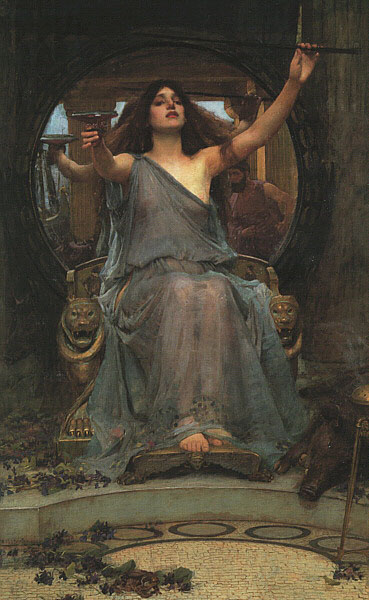
I often wonder about the resolve - sophrosyne - of Ulysses in the heart of the siren's songs....
What pulled him out of Circe's arms.... What kept him directed back towards Ithaca...


[ source ]